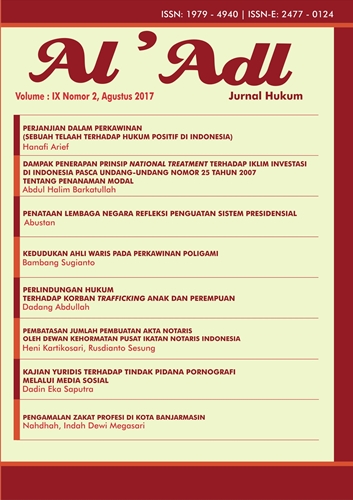
PENGAMALAN ZAKAT PROFESI DI KOTA BANJARMASIN
DOI:
https://doi.org/10.31602/al-adl.v9i2.950Keywords:
practice, zakat, profession, pengamalan, profesiAbstract
This research aims to study the percentage of profession zakat (purification/ support of the needy) in Banjarmasin. Theoretically, it is also expected to enrich the Islamic knowledge particularly in the field of Islamic social jurisprudence practice.This field research focuses on the zakat givers (professionals) living in Banjarmasin, and studies some cases of any professions. In further, by qualitative approach the research gains data to build a deep understanding of zakat givers experiences in calculating their percentage of zakat.The percentage which is due on gold, silver and cash funds that have reached the amount of 85 grams of gold and held in possession for one lunar year is two and a half percent.A person may also give as much as he or she pleases as voluntary charity to muzakki (the needs), or through the legal institution.References
Ali, Mohammad Daud, 1988, Sistem Ekonomi Islam, Zakat dan Wakaf, UI-Press, Jakarta.
Hafidhuddin, Didin, 2002, Panduan Praktis Tentang Zakat, Infaq, Sedekah; Zakat dalam Perekonomian Modern,Gema Insani, Jakarta.
Qardhawi, Yusuf, 2008, Zakat dalam Perekonomian Modern, Gema Insani, cet. VI, Jakarta.
Peraturan Menteri Agama Republik Indonesia No. 52 tahun 2014 tentang Syarat dan Tata Cara Penghitungan Zakat Mal dan Zakat Fitrah Serta Pendayagunaan Zakat untuk Usaha Produktif.
Downloads
Published
2017-11-08
Issue
Section
Artikel
License
Authors who publish with this journal agree to the following terms:
- Authors retain copyright and grant the journal right of first publication with the work simultaneously licensed under a Creative Commons Attribution License that allows others to share the work with an acknowledgment of the work's authorship and initial publication in this journal.
- Authors are able to enter into separate, additional contractual arrangements for the non-exclusive distribution of the journal's published version of the work (e.g., post it to an institutional repository or publish it in a book), with an acknowledgment of its initial publication in this journal.
- Authors are permitted and encouraged to post their work online (e.g., in institutional repositories or on their website) prior to and during the submission process, as it can lead to productive exchanges, as well as earlier and greater citation of published work (See The Effect of Open Access).