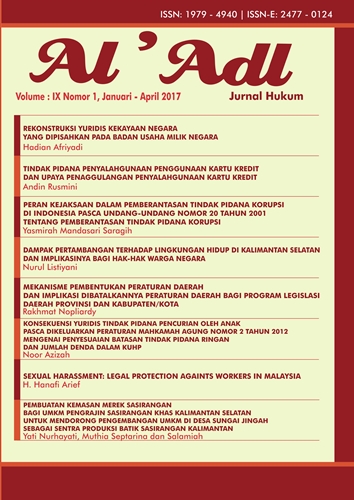
REKONSTRUKSI YURIDIS KEKAYAAN NEGARA YANG DIPISAHKAN PADA BADAN USAHA MILIK NEGARA
DOI:
https://doi.org/10.31602/al-adl.v9i1.800Abstract
Abstract
The Achievement of purpose of the state is always related to state finance as the financing of the operation of the government. In order to get the state finance, it must remain within the legal framework that is allowed by the 1945 Constitution. The problems of state finance management get a lot of attention. The state finance management through regulation definition of state finances,ideally will be very promising for the country's financial rescue efforts of irregularities, but it will become problems if correlated with other regulations. Enactment of the Act Number 19 of 2003 on State-Owned Enterprises, has created a contradictory climate and polemical state finances statusin State-Owned Enterprises environment both in ownership and in management and supervision. The specifications of this research was done by normative juridical approach, ie testing and reviewing secondary data. With regard to the normative juridical approach that is used, the research was conducted in two phases, namely the study of literature and field research that are merely supporting, data analysis used is the analysis of qualitative juridical, ie the data obtained, and then arranged systematically, comprehensively and integratedly to achieve the clarity of the issues that will be analyzed. According to Article 2 of Act Number 17 of 2003 on State Finance, state assets stated aside the scope of state finances. Based on the results of the research, separated state asset is not a state financial scope. In this case, the state budget may not overcome the losses resulted from the management of State-Owned Enterprises.
Keywords: Juridical Reconstruction, State Property, State-Owned Enterprises.
Downloads
Published
Issue
Section
License
Authors who publish with this journal agree to the following terms:
- Authors retain copyright and grant the journal right of first publication with the work simultaneously licensed under a Creative Commons Attribution License that allows others to share the work with an acknowledgment of the work's authorship and initial publication in this journal.
- Authors are able to enter into separate, additional contractual arrangements for the non-exclusive distribution of the journal's published version of the work (e.g., post it to an institutional repository or publish it in a book), with an acknowledgment of its initial publication in this journal.
- Authors are permitted and encouraged to post their work online (e.g., in institutional repositories or on their website) prior to and during the submission process, as it can lead to productive exchanges, as well as earlier and greater citation of published work (See The Effect of Open Access).